
Incorporates Learning Strategies, Teaching Methods, and Materials That Are Culturally Responsive and Inclusive
Description: Effective curricula have materials that are free of culturally biased, oppressive, and discriminatory information, scenarios, examples, images, graphics, and audiovisuals.
All curricula contents (e.g., information, student-learning activities, and assessments) depict and are inclusive of diverse student demographics, identities, cultures, health behaviors, and lived experiences. This includes but is not limited to the variety of sexes, gender identities and expressions, races, ethnicities, classes, religions, ages, geographic regions, physical and mental abilities, appearances, sexual identities and orientations, and family or caregiving structures identified and experienced by students. Strategies that promote values, attitudes, and behaviors that acknowledge and affirm the cultural diversity of each student; optimize relevance to students from multiple cultures in the school community; strengthen students’ skills necessary to engage in intercultural interactions; and build on the cultural assets and resources of families and communities are necessary in health education curricula and instruction.1
According to the Centers for Disease Control and Prevention’s Health Education Curriculum Analysis Tool (HECAT), characteristics of culturally responsive and inclusive health education curricula should include the following elements:2
- Health content and skills tailored to specific student demographics (e.g., race, ethnicity, sex, age, and grade), identities, health behaviors, and lived experiences
- Consistent incorporation of diverse identities, cultures, narratives, and beliefs throughout curriculum lessons, activities, and assessments
- Consideration of the social determinants of individual and community health from diverse social, cultural, political, and historical contexts across health topic areas
- Opportunities for students to think critically about individual (e.g., implicit bias) and systemic (e.g., institutionalized racism) factors that perpetuate health disparities and serve as barriers to health equity
- Incorporated strategies to help students navigate or combat stressors (e.g., discrimination, harassment, or stereotypes) and systems of oppression that negatively impact health3
- Data, scenarios, and examples that communicate a positive framing of health and human development and that represent people of diverse races, ethnicities, classes, sexes, genders, abilities, and sexual orientations through strengths, achievements, and assets rather than perceived deficits
Example 1
For this teaching example, the lesson being taught is influences on food choices, and the HBO for this lesson is FN-11: Choose and enjoy nutrient-dense foods and beverages that reflect personal preferences, culture, and budget (HECAT Appendix 3).
- The teacher reviewed the food and nutrition knowledge expectations listed in the HECAT (https://www.cdc.gov/healthyyouth/hecat/index.htm) for students in grades 3–5 that are aligned with the HBO for this lesson and selected the following knowledge expectation for this lesson: explain the importance of trying new foods.
- The teacher also reviewed the HECAT (https://www.cdc.gov/healthyyouth/hecat/index.htm) and elected to use the first six of the eight food and nutrition skill expectations that are aligned with the health-related skill of analyzing influences for students in grades 3–5.
- Identify how culture influences food choices and other eating practices and behaviors.
- Identify how peers influence food choices and other eating practices and behaviors.
- Identify how community influences food choices and other eating practices and behaviors.
- Identify how family and culture influence food choices and other eating practices and behaviors.
- Identify how school and community settings influence food choices and other eating practices and behaviors.
- Identify how media and technology influence food choices and other eating practices and behaviors.
- The teacher starts the lesson by telling students that in this lesson they will be analyzing influences on food choices and other eating practices.
- Students participate in a think- pair-share to define the word “influence.” The teacher and students compare and discuss definitions of “influence.” The teacher explains that the word “influence” means having power to affect how someone thinks or behaves.
- Students participate in another think-pair-share to define the word “counter.” The teacher and students compare and discuss definitions of “counter.” The teacher tells students that the word “counter” means responses go against or oppose an influence on how someone thinks or behaves.
- The teacher asks the students to complete a worksheet which includes a table with the following text:
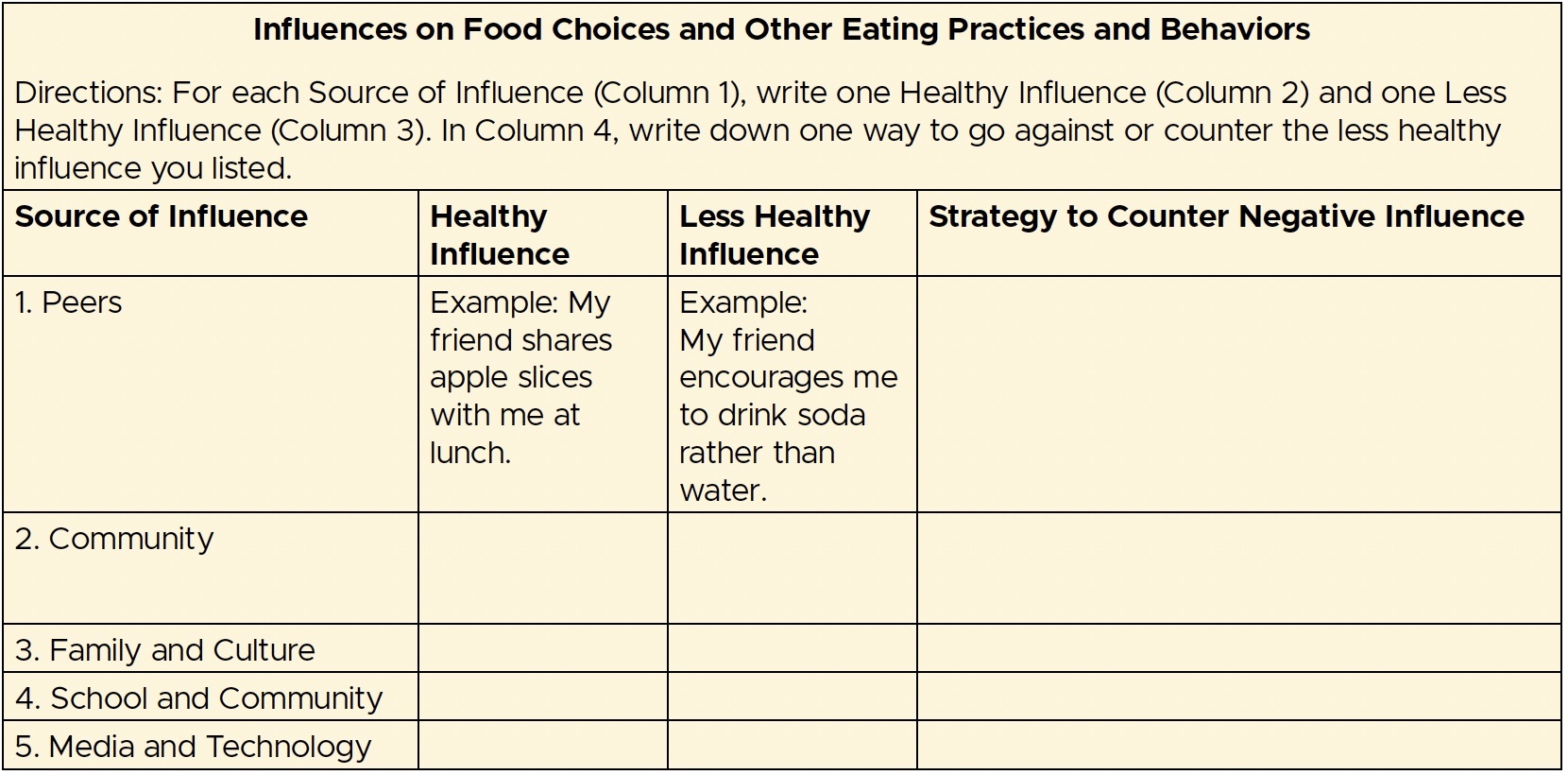
- The teacher provides an example of a healthy influence on eating behaviors and practices: “My friend shares apple slices with me at lunch.” The teacher also provides an example of a less healthy influence on eating behaviors and practices: “My friend encourages me to drink soda rather than water.”
- The teacher has the students complete the worksheet independently. Once the students have finished completing the worksheet, they compare and discuss responses with a partner.
- The teacher then has each set of partners join another set of partners to create groups of four students. The groups then compare and discuss the strategies they identified to counter the less healthy influences on food choices and other eating practices and behaviors.
- While the students are comparing responses, the teacher writes the following sources of influences on the whiteboard:
- Peers
- Community
- Family and Culture
- School
- Community
- Media and Technology
- Once the students have completed their work, they write the strategies they identified to counter the less healthy influences for each source of influence on the whiteboard.
- The teacher and the students discuss the strategies they identified to counter less healthy influences on food choices and other eating practices and behaviors.
- The teacher asks the students to use their fingers (1 is low, and 5 is high) to rate confidence in their abilities to
- identify healthy influences on food choices and other eating practices and behaviors,
- identify less healthy influences on food choices and other eating practices and behaviors, and
- counter less healthy influences on food choices and other eating practices and behaviors.
Example 2
For this teaching example, the lesson being taught is expressing empathy and compassion, and the HBO for this lesson is SH-3: Treat all people with dignity and respect regarding gender identity and sexual orientation (HECAT Appendix 3).
- The teacher reviewed the 10 sexual health knowledge expectations listed in the HECAT (https://www.cdc.gov/healthyyouth/hecat/index.htm) that are aligned with the HBOs for this lesson for students in grades 3–5. Prior learning for this lesson included the following knowledge expectations:
- Define gender identity and expression.
- Explain the difference between sex assigned at birth and gender identity and expression.
- Define sexual orientation (i.e., patterns of emotional, romantic, or sexual attractions to men, women, or all sexes), including sense of identity, attractions, and related behaviors (e.g., heterosexual, gay/ lesbian, or bisexual).
- Describe personal characteristics related to sexual identity, orientation, and gender that make people different from one another.
This is the knowledge expectation for this lesson:
a. Summarize why it is wrong to tease or bully others based on gender identity, sexual orientation, or other personal characteristics (e.g., sex, race, ethnicity, culture, appearance, abilities, mannerisms, or the way one dresses or acts).
- The teacher also reviewed the HECAT (https://www.cdc.gov/healthyyouth/hecat/index.htm) and selected to use the following sexual health skill expectation that is aligned with the health-related skill of interpersonal communication for students in grades 3–5:
- Explain how to be empathetic and compassionate toward others who have a different gender identity and expression or sexual orientation from oneself.
- The teacher uses the identified knowledge and skill expectation to create the lesson on expressing empathy and compassion.
- The teachers starts the lesson by explaining the terms “empathy” and “compassion.” Empathy is the ability to understand and share the feelings of another person. Compassion is when we care about others, treat them with kindness, and feel a need to help people.
- The teacher asks the students to identify situations when they have shown empathy and compassion to others. Examples of these situations may include
- telling a friend who has a gender identity of female that you like the color of their fingernail polish, and
- continuing to be friends with a classmate after they reveal that their sexual orientation is different from your sexual orientation.
- The teacher uses the following steps to help students develop skills for expressing empathy and compassion:
- The teacher and the students discuss the importance of expressing empathy and compassion.
- The teacher presents examples of verbal messages to express empathy and compassion as well as body language to support the verbal message:
- The verbal message conveys understanding and respect for feelings of a classmate.
- The verbal message conveys care and kindness to a classmate.
- The verbal message includes an offer of support or help to a classmate.
- Body language including tone of voice supports the student’s verbal message.
- The teacher demonstrates how to express empathy and compassion.
- Students practice and rehearse expressing empathy and compassion using real-life scenarios with a partner.
- The teacher uses the following checklist to assess and provide the students with reinforcement and feedback regarding their expressions of empathy and compassion:
- The verbal message conveys understanding and respect for feelings of a classmate.
- The verbal message conveys care and kindness to a classmate.
- The verbal message includes an offer of support or help to a classmate.
- The body language including tone of voice supports the student’s verbal message. The teacher concludes the lesson by asking the students to identify situations when it is important to express empathy and compassion to others. The teacher also asks the students to use their fingers (1 is low, and 5 is high) to rate confidence in their ability to express empathy and compassion to others.
- The teacher concludes the lesson by asking the students to identify situations when it is important to express empathy and compassion to others. The teacher also asks the students to use their fingers (1 is low, and 5 is high) to rate confidence in their ability to express empathy and compassion to others.
To see in PDF format, please click here.