

Provides Adequate Time for Instruction and Learning
Description: An effective curriculum provides enough time to promote understanding of key health concepts and practice skills. Behavior change requires an intensive and sustained effort. A short-term or one-shot curriculum, delivered for a few hours at one grade level, is generally insufficient to support the adoption and maintenance of healthy behaviors.1
Many school districts in the country limit the amount of time required to teach health education. If there is limited time to teach health education, it is more important to choose fewer health content areas and healthy behavior outcomes (HBOs) and teach those health content areas well. (Less is more.) Trying to teach every health content area and every related HBO should be avoided. Students need adequate time to learn and understand functional health knowledge and related essential skills to help them adopt and maintain healthy behaviors.
To meet this characteristic, it is important for health teachers, curriculum coordinators, and School Health Advisory Councils to advocate for more dedicated time to teach health education. Creating policies that mandate health education at every grade level will help with meeting this characteristic.

Example 1
1. A committee representing prekindergarten (Pre-K) to grade 5 classroom teachers, grades 6 to 12 health education teachers, grades K to 12 physical education teachers, other grades Pre-K to 12 school personnel (e.g., nurses, social workers, counselors, and administrators), and community partners (e.g., public health, county extension, faith leaders, or medical personnel) collaborate to develop a Pre-K to 12 scope and sequence for health education.
2. The committee receives professional development related to the National Health Education Standards, the CDC’s characteristics of an effective health education curriculum, and the HECAT.
3. The committee then follows the steps delineated in the HECAT for developing a scope and sequence. (Refer to https://www.cdc.gov/healthyyouth/hecat/pdf/2021/hecat_appendix_05.pdf and https://www. cdc.gov/healthyyouth/hecat/pdf/scope_and_sequence.pdf.)
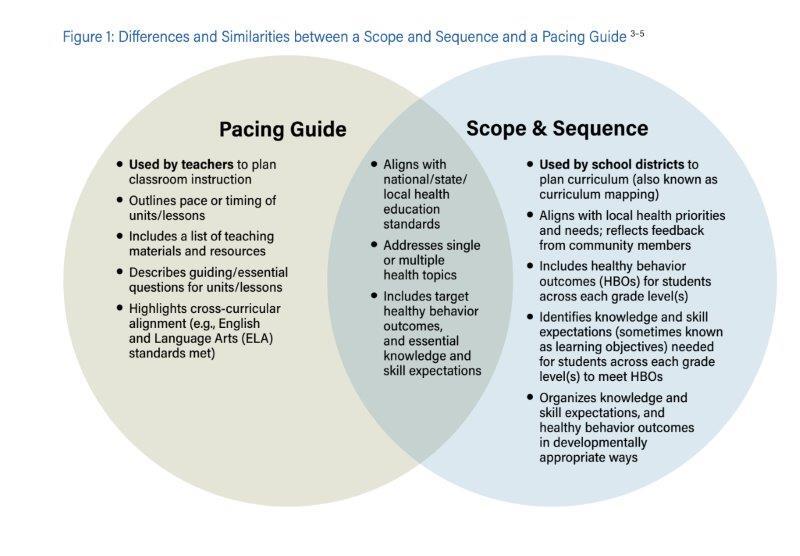
4. While discussing the amount of health instructional time allocated for elementary students, the classroom teachers and curriculum director tell the committee that less than 150 minutes per year is allocated to health education for students in grades Pre-K to 5.
5. Given that the school’s curriculum director had already used grant funding to purchase a comprehensive health education curriculum for students in kindergarten to grade 5, the teachers and curriculum director inform the committee that instructional time at the elementary level would be increased so that teachers would have time to teach all lessons in the curriculum for students in kindergarten to grades 5. Therefore, students would receive 29 lessons in grade 3, 28 lessons in grade 4, and 38 lessons in grade 5.
To view in PDF format, please click here.