
Addresses Social Pressures and Influences
Description: An effective curriculum provides opportunities for students to analyze personal and social pressures to engage in risky behaviors.1 These pressures include media influences, peer pressure, and social and structural barriers. Pressure from media sources may include television commercials encouraging alcohol and drug use, social media content exposing and perpetuating messages about “idealized” body types, or bullying and harassment. Peer pressure to engage in risky health behaviors may include friends or peers pressuring one another to vape or use marijuana, have unprotected sex, or bully others. Social and structural barriers that increase the likelihood of adolescents engaging in or experiencing risky behaviors include poverty, racism, financial and gender inequality, lack of access to health services, stigma related to HIV and other sexually transmitted infections, and homophobic and transphobic viewpoints. This characteristic is aligned with National Health Education Standard 2: Students will analyze the influence of family, peers, culture, media, technology, and other factors on health behaviors.2
Example 1
For this example, the lesson that is being taught is influences on safe and risky behaviors, and the HBOs for the lesson are S-3: Use safety equipment appropriately and correctly and PA-6: Avoid injury during physical activity (HECAT Appendix 3).
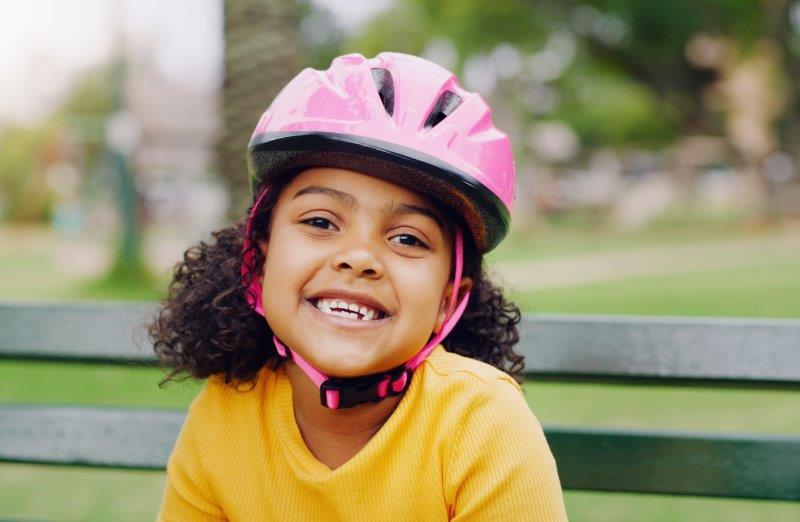
- For this lesson, students have already learned the functional health information about how injuries can be prevented, examples of dangerous or risky behaviors, and why it is important to wear a helmet or other appropriate protective gear when participating in sports and other physical activities.
- The focus of this lesson is on family, peer, school, community, and media influences on the use of helmets or other protective gear when participating in sports and other physical activities.
- The teacher begins the lesson by asking the following questions:
- What does it mean to be influenced by someone to do something safe, like wearing a bike helmet?
- Who are people who influence you to wear a bike helmet?
- The teacher then explains that people can be a positive influence by encouraging others to do something safe or a negative influence by encouraging others to do something that is not safe.
- The teacher also explains that students can also be positively influenced to do safe things and negatively influenced to do unsafe things while at home, at school, or in the community.
- The teacher then tells the students that they are going to select a specific sport or physical activity to identify positive and negative influences on the use of helmets or other protective gear.
- Students are asked to complete the following worksheet to identify positive and negative influences of helmet use and/or other protective gear.
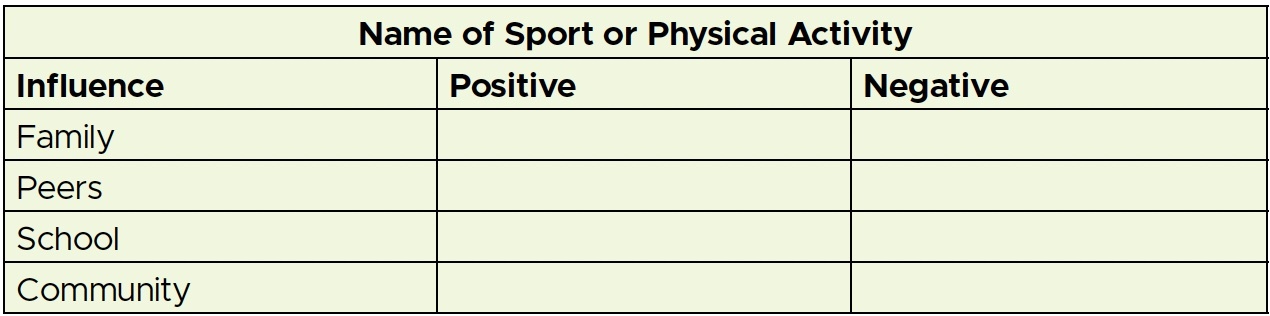
- Students are asked to share examples of positive and negative influences on the use of helmets and/or other protective gear.
- Students are given a partner who selected the same or similar sport or physical activity. The students identify how they could counter two of the identified negative influences so that students always use helmets and other protective gear.
- The teacher calls on pairs to share strategies.
- The teacher concludes the lesson by encouraging students to be positive influences on one another. The teacher also urges the students to listen to people who encourage them to use helmets or other protective gear when participating in sports and other physical activities.
Example 2
For this example, the lesson that is being taught is the influence of social media and technology on bullying, and the HBO for this lesson is V-3: Avoid bullying or being a bystander to bullying, or being a victim of bullying (HECAT Appendix 3).
- For this lesson, the students have already learned functional health information to help them with the following actions:
- Describing the difference between bullying and teasing
- Explaining why it is wrong to tease or bully others based on personal characteristics
- Describing what to do if oneself or someone else is being bullied
- Explaining the difference between tattling and reporting aggression, bullying, or violence
The students have also identified trusted adults at home, at school, and in the community whom they can ask for help, and they’ve learned how to ask those trusted adults for help when bullied.
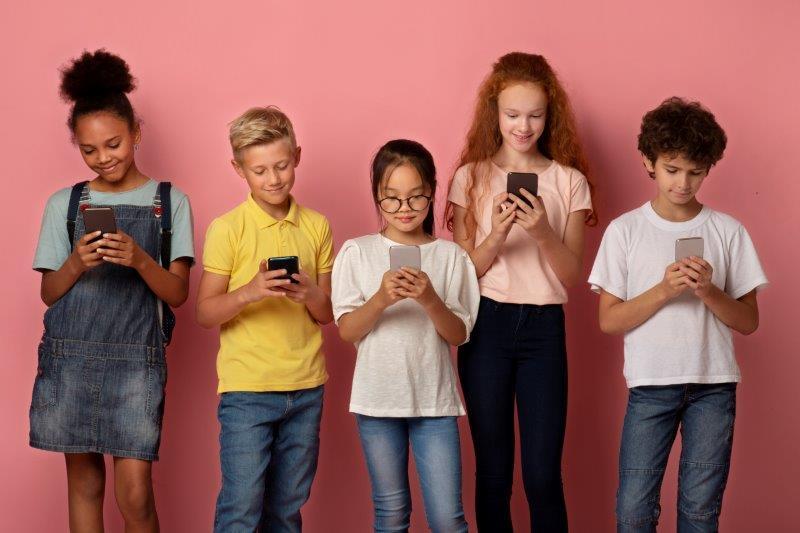
- The focus for this lesson is on identifying the influence of social media and technology on bullying.
- The teacher begins the lesson by asking the following questions:
- What does it mean to influence someone? (“Influence” means to have an effect on another person.)
- Can this influence be positive?
- Can this influence be negative?
- What is social media? (“Social media” is a form of communication with others through the use of phones, computers, tablets, and other devices by using Snapchat, Instagram, TikTok, Omegie, House Party, or other online platforms.)
- Can social media have a positive influence on people? How?
- Can social media have a negative influence on people? How?
- The teacher breaks the students into groups of three to four people to brainstorm responses to the following question:
- What are rules you should follow to be safe while using social media?
- The teacher asks students the following question about different scenarios:
- Why should you always talk with your parents or other trusted adults in the following situations?
- You are contacted by someone you don’t know or who pretends to be someone you do know.
- Someone says mean things, bullies, or threatens you.
- Someone asks you to tell them your name, birthday, school, or address.
- Someone asks you to give them your picture.
- Someone sends you a picture of themselves without your permission.
- Someone asks to meet you in person.
- Why should you always talk with your parents or other trusted adults in the following situations?
- The teacher concludes the lesson by encouraging students to
- Be positive influences on social media,
- Follow the rules for safe use of social media, and
- Always talk with a trusted adult in these situations:
- When students are contacted by someone they don’t know or who pretends to be someone they know,
- When someone says mean things, bullies, or threatens them,
- When someone asks for personal information and/or their picture, and
- When someone asks to meet them.
To see in PDF format, please click here.