

Provides Adequate Time for Instruction and Learning
Description: An effective curriculum provides enough time to promote understanding of key health concepts and practice skills. Behavior change requires an intensive and sustained effort. A short-term or one-shot curriculum, delivered for a few hours at one grade level, is generally insufficient to support the adoption and maintenance of healthy behaviors.1
Many school districts in the country limit the amount of time required to teach health education. If there is limited time to teach health education, it is more important to choose fewer health content areas and healthy behavior outcomes (HBOs) and teach those health content areas well. (Less is more.) Trying to teach every health content area and every related HBO should be avoided. Students need adequate time to learn and understand functional health knowledge and related essential skills to help them adopt and maintain healthy behaviors.
To meet this characteristic, it is important for health teachers, curriculum coordinators, and School Health Advisory Councils to advocate for more dedicated time to teach health education. Creating policies that mandate health education at every grade level will help with meeting this characteristic.

Example 1
- For this example, a new middle school administration has cited a need to focus more time on subjects that are tested and reported to the state, and as a result, has cut health education in 6th grade. This change leaves the health education program with only 10 hours of classroom instruction in each of grades 7 and 8.
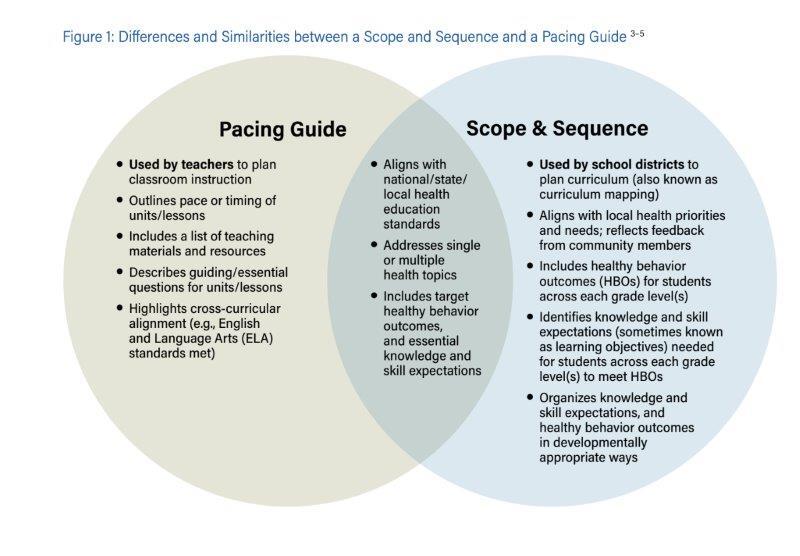
- The health educators meet and decide that given this cut, they must “go deeper rather than wider” with their instruction to address the health behaviors of their students. Knowing that the number of classes is very limited and that each class is vital, they follow the guidance from the HECAT to develop a scope and sequence and to ensure that their 7th and 8th grade curriculum is aligned and sequential.(Refer to https://www.cdc.gov/healthyyouth/hecat/pdf/2021/hecat_appendix_05.pdf and https://www. cdc.gov/healthyyouth/hecat/pdf/scope_and_sequence.pdf.)
- Upon analyzing local data, the health educators determine that two priority content areas for each grade will be selected, and each are coupled with two to three skills. The teachers identify the HBOs and knowledge and skill expectations, and two units of study are developed for each grade.
- Given the limited instructional time, this process allows for alignment and helps to avoid duplication while allowing for reinforcement of content and skill development over the two grades.
To view in PDF format, please click here.