

Provides Adequate Time for Instruction and Learning
Description: An effective curriculum provides enough time to promote understanding of key health concepts and practice skills. Behavior change requires an intensive and sustained effort. A short-term or one-shot curriculum, delivered for a few hours at one grade level, is generally insufficient to support the adoption and maintenance of healthy behaviors.1
Many school districts in the country limit the amount of time required to teach health education. If there is limited time to teach health education, it is more important to choose fewer health content areas and healthy behavior outcomes (HBOs) and teach those health content areas well. (Less is more.) Trying to teach every health content area and every related HBO should be avoided. Students need adequate time to learn and understand functional health knowledge and related essential skills to help them adopt and maintain healthy behaviors.
To meet this characteristic, it is important for health teachers, curriculum coordinators, and School Health Advisory Councils to advocate for more dedicated time to teach health education. Creating policies that mandate health education at every grade level will help with meeting this characteristic.

Example 1
- For this example, a one-semester health class is a state requirement for graduation (18 weeks of instruction). This school district also requires a 9-week health education course at the 7th grade level. The health education curriculum coordinator works with select middle and high school health teachers in the district to develop a health education scope and sequence using the HECAT for guidance. (Refer to https://www.cdc.gov/healthyyouth/hecat/pdf/2021/hecat_appendix_05.pdf and https://www. cdc.gov/healthyyouth/hecat/pdf/scope_and_sequence.pdf).
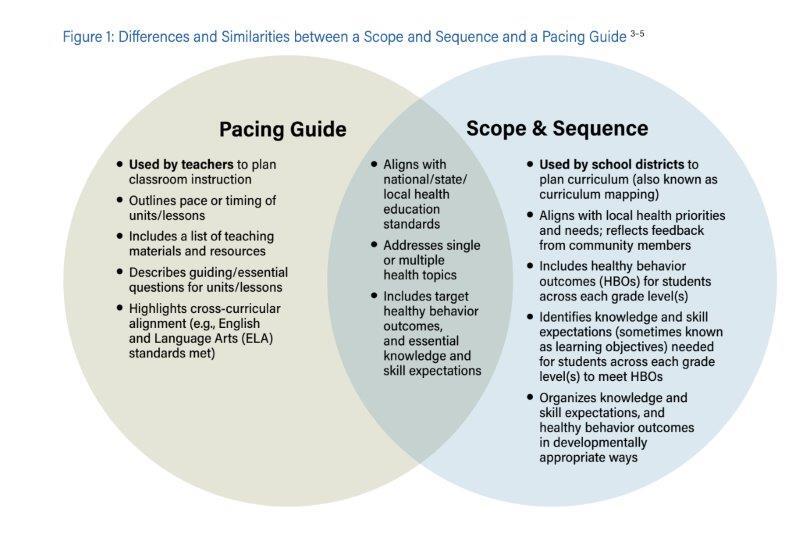
- A scope and sequence provides a picture of a school district’s entire curriculum in a subject area. A health education scope and sequence outlines the breadth and arrangement of key health topics and concepts across grade levels (scope), and the logical progression of essential health knowledge, skills, and HBOs to be addressed at each grade level (sequence) where health education is being taught. A health education scope and sequence should identify what students should know and do at the end of each grade or grade span and when it should be taught.
- There are several steps to take when developing a health education scope and sequence.
- Determine the necessary health education standards or benchmarks and additional knowledge and skill expectations required at the local level.
- Clarify health priorities by using local, state, and national health data on youth health-related behaviors, including health problems and risk-taking behaviors among school-aged youth.
- Select key health topics, based on data that should be addressed at each grade level where health education is taught.
- Identify and prioritize the expected HBOs for students for each topic that will meet the needs of the community and school district.
- Determine the essential knowledge and skill expectations that directly relate to the HBOs for each health topic. The knowledge and skill expectations should specify what students should know and be able to do in relation to each of the key health topics and align with standards or benchmarks.
- Decide specifically when each of the essential health education knowledge and skill expectations should be taught across the curriculum for all grades.
- Determine the overall amount of instructional time. Allow sufficient time for each of the following:
- For each knowledge and skill expectation to be introduced, reinforced, and mastered
- For students to successfully develop the breadth and depth of knowledge of all health education concepts
- For students to be able to perform all health-behavior skills
- Review and validate the scope and sequence
- Review and validate the scope and sequence.
- Creating a health education scope and sequence provides guidance to all health teachers and can help them avoid trying to teach too many health content areas. In this example, when developing the scope and sequence, the health education curriculum coordinator and health teachers limit the number of health content areas they will teach. They understand that there isn’t enough time to adequately address every content area and the corresponding HBOs.

To view in PDF format, please click here.