

Addresses Personal Values, Attitudes, and Beliefs
Description: An effective health education curriculum fosters personal attitudes, values, and beliefs to support positive health behaviors. Attitudes are the way a person thinks and feels about something or someone, values are individual beliefs that motivate people to act one way or another, and beliefs are ideas that a person accepts or considers to be true.
An effective health education curriculum provides instructional strategies and learning experiences that motivate students to critically examine personal perspectives, thoughtfully consider new arguments to support health-promoting attitudes and values, and generate positive perceptions about protective behaviors and negative perceptions about risk behaviors. Students develop attitudes, values, and beliefs that support healthy behavior through experience and exposure to others modeling the health-enhancing attitudes, values, and beliefs.1
This characteristic is not values clarification (e.g., engaging students in a debate that focuses on whether marijuana should be legalized for recreational use); instead, it describes learning experiences that encourage students to critically think about how their own attitudes, values, and beliefs support the adoption of healthy behaviors.
It is important to establish and maintain a classroom climate in which the teacher and the students consistently model and endorse healthy attitudes, values, and beliefs. It is the teacher’s role to be the “bridge builder” to help students to take the functional information learned and apply it to their lives and to foster new attitudes, values, and beliefs needed to adopt healthy behaviors.
Example 1
For this example, the unit that is being taught is Tobacco Prevention, and the HBO for the lesson is T-1: Avoid using (or experimenting with) any form of tobacco (HECAT Appendix 3).
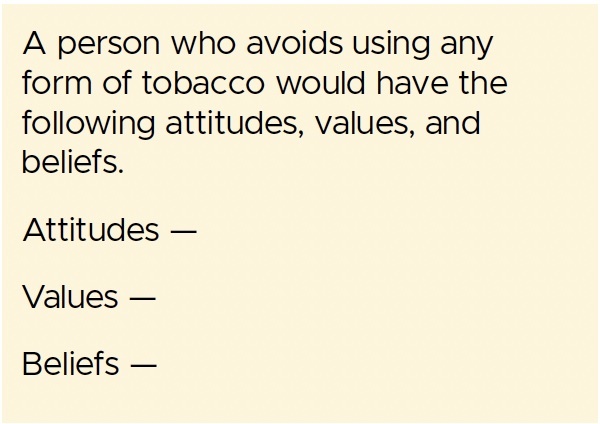
- The students have already learned about the negative consequences of experimenting with or using any forms of tobacco and the benefits of being tobacco free.
- The teacher asks students to meet with their shoulder partner and brainstorm the meaning of these words: “attitudes,” “values,” and “beliefs.” The teacher calls on several students to share their definitions out loud.
- The teacher shares the following definitions with the students, comparing students’ answers with the definitions they are sharing.
- Attitudes are the way you think and feel about something or someone.
- Values are individual beliefs that motivate people to act one way or another.
- Beliefs are something that are accepted or considered to be true.
- The teacher explains when individuals practice a health-enhancing behavior, they typically have healthy attitudes, values, and beliefs toward that behavior.
- The teacher then divides students into small groups and asks them to go to a designated piece of chart paper hanging on the wall. Students brainstorm healthy attitudes, values, and beliefs a person would have if they avoided using any form of tobacco.
- After each group finishes completing their list, the teacher calls on each group to share two examples for each word.
- The teacher asks students to complete the following questions.
- What are two healthy attitudes that would most help young people avoid using any form of tobacco?
- What are two healthy beliefs that would most help young people avoid using any form of tobacco?
- What are two healthy values that would most help young people avoid using any form of tobacco?
- The teacher calls on volunteers to share their answers.

Example 2
For this example, the unit that is being taught is Physical Activity, and the HBO for the lesson is PA-1: Engage in moderate to vigorous physical activity for at least 60 minutes every day (HECAT Appendix 3).

- Students have already learned about the benefits of participating in vigorous physical activity for at least 60 minutes every day.
- The teacher asks students to create an online poster (e.g., PowerPoint, Canva, Prezi) of physical activities they enjoy and the personal benefits they get when they participate in physical activity.
- After students have a draft of their online posters, students are placed in small groups to share their posters. Group members are encouraged to share at least one thing they like about the poster and one way it could be improved.
- Students work individually to improve their posters based on peer feedback from their group. Students present their posters to the entire class.
To see in PDF format, please click here.