
Builds Personal Competence, Social Competence, and Self-Efficacy by Addressing Skills
Description: An effective curriculum builds essential health-enhancing skills that enable students to build their personal confidence, deal with social pressures, and avoid or reduce risk behaviors. Essential health-enhancing skills included in the National Health Education Standards1 and the Centers for Disease Control and Prevention’s (CDC’s) Health Education Curriculum Analysis Tool (HECAT)2 are
- Analysis of internal and external influences,
- Assessment of valid and reliable health information, products, and services,
- Communication skills (e.g., refusal, conflict resolution, negotiation, and expressing feelings),
- Decision-making,
- Goal setting,
- Self-management, and
- Advocacy.
Health skills are critically important to teach in every health unit that is taught at each grade level. The goal for school districts is to teach every health skill at least two times, in two different health content areas, at every grade level. Therefore, it is important for curriculum directors and health teachers to be purposeful and thoughtful about which skills to include in each health content area and at each grade level. Several questions should be answered when making these decisions.
- Which skill(s) will be most likely to help students adopt the selected Healthy Behavior Outcomes (HBOs) in the unit?
- How many lessons are dedicated to each health topic that is taught?
- What is the developmental level of the students?
- What skills have already been taught at this grade level in other units?
- What health skills are being taught at each grade level for each topic that is taught (scope and sequence)?

Once decisions have been made regarding the health skills to be included in each health content area at each grade level, teachers may find the HECAT helpful. The HECAT includes a list of priority skill expectations to further delineate the health skills for each grade level span (e.g., K–2, 3–5, 6–8, and 9–12) (HECAT Skill Expectations).
For students to be successful in mastering a health education skill, lessons need to include the following instructional developmental steps:
Step 1: Discuss the importance of the skill, its relevance, and its relationship to other learned skills.
Step 2: Present steps for developing the skill.
Step 3: Model the skill.
Step 4: Practice and rehearse the skill using real-life scenarios.
Step 5: Provide feedback and reinforcement.
When teaching a health skill, all these steps are imperative. It isn’t adequate to introduce the skill, present the steps of the skill, and model the skill. If students don’t have multiple opportunities to practice and apply the skill and receive feedback, it is unrealistic to expect students to master the skill.
Example 1
The unit being taught is Food and Nutrition, and the HBOs for the lesson are FN-1: Follow a healthy eating pattern that meets individual preferences and needs for growth and development; FN-2: Choose a variety of options within each food group; FN-3: Eat lots of fruits and vegetables; FN-4: Choose to eat whole-grain products; FN-5: Choose to drink or eat fat-free or low-fat dairy or fortified-dairy alternatives; FN-6: Drink lots of water; FN-7: Avoid sugary drinks; FN-8: Limit foods high in added sugars, saturated fats, trans fats, and sodium; and FN-9: Choose to eat or drink nutrient-dense foods and beverages when dining (HECAT Appendix 3).

- The focus for this activity is goal setting. Prior to this activity, students have already learned functional health information about healthy eating. They also completed a food diary for 2 days and determined their strengths and weaknesses related to their eating behaviors.
- Step 1: Discuss the importance of the skill, its relevance, and its relationship to other learned skills. The teacher starts the activity by asking students if they have ever set a goal before. The teacher then calls on several students to share their goals and asks the students to share how it felt if they reached those goals. The teacher explains that students are going to learn how to set a goal, the steps to reaching that goal, and how they can use the skill of goal setting in many aspects of their life. The teacher then tells the students they have the ability to learn how to effectively set goals to improve their nutritional habits.
- Step 2: Present steps for developing the skill and Step 3: Model the skill. (These steps are sometimes taught together — the teacher will explain and then model the steps of goal setting).
- The teacher asks students to review the results of their food diary activity and determine an area of weakness in which they would like to improve.
- The steps of writing a SMART goal are then presented. The qualities of a SMART goal are as follows:
- S—the goal is specific. (What will be accomplished?)
- M—the goal is measurable. (How will you know the goal was met?)
- A—the goal is achievable. (Is the goal doable? Do you have the resources to reach the goal?)
- R—the goal is realistic. (Is the goal within reach and relevant to your life?)
- T—the goal is time bound. (What is the time frame for achieving the goal?)
(Note: It is helpful for the teacher to have several SMART goals written related to each HBO so that students can select one. If not, a lot of time can be spent on just writing a SMART goal.)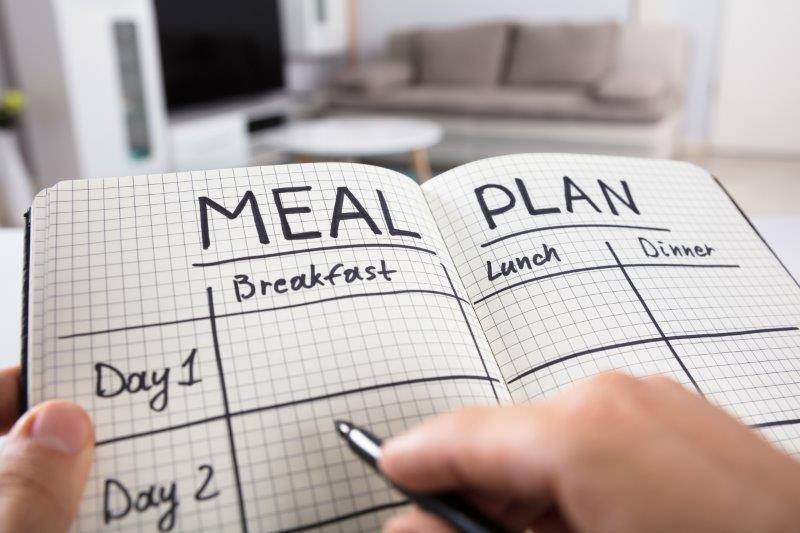
- The teacher shows examples of SMART goals related to healthy eating (e.g., I will eat fruit for a snack instead of junk food at least three times this week, I will order a salad instead of fries when I go to a fast-food restaurant, I will eat five servings of fruit and vegetables 5 days a week). The teacher then uses the following SMART goal for demonstration purposes: I will drink 64 ounces of water every day.
- Next, the teacher reviews additional goal-setting steps along with examples.
- What are the benefits I can expect if I reach the goal? (e.g., I will have more energy and improved brain function.)
- What steps do I need to take to reach my goal? (e.g., I will fill up a container with 64 ounces of water every day and drink from it throughout the day.)
- What are barriers (i.e., things that will get in the way) to reaching my goal, and how can I overcome these barriers? (e.g., I might forget the container, so I will write a reminder sticky note and place it on the door I go out of in the morning.)
- Step 4: Practice and rehearse the skill using real-life scenarios. After reviewing the goal-setting steps and providing an example to the students, the teacher directs students to write their own SMART goals and related action steps based on one of their weaknesses from their food diaries. It is helpful if the teacher creates an activity sheet with each of the goal-setting steps on it for the students to complete.
- Step 5: Provide feedback and reinforcement. The students should share their completed SMART goals and steps with a partner and/or the teacher for feedback. Then, the students should be assigned to track their goals for at least 3 weeks. (The teacher should provide a tracking worksheet to help students keep track of their progress.) The teacher provides opportunities for students to adjust their goals if they are too challenging or too easy. Throughout the goal-tracking process, the teacher asks students how their confidence levels are changing in setting, revising, and achieving their goals.
Example 2
The unit that is being taught is Personal Health and Wellness, and the HBO for the lesson is PHW-2: Get an appropriate amount of sleep and rest (HECAT Appendix 3).

- The focus for this activity is on accessing valid and reliable health information. Students will learn how to access information that will encourage them to get an appropriate amount of sleep and rest.
- Step 1: Discuss the importance of the skill, its relevance, and its relationship to other learned skills. The teacher begins the activity by asking students where they find information when they have a question they want answered. The teacher then calls on several students and lists their answers on the board (e.g., Facebook, Instagram, the internet). The teacher explains that most of the sources that they listed do not contain accurate and truthful information. The teacher then explains that in today’s activity, they are going to learn and become confident in locating accurate and truthful health information on the internet.
- Step 2: Present steps for developing the skill. There are rules that should be followed to help determine if information on the internet is accurate and truthful. The teacher asks students to meet with a partner and brainstorm potential rules they think would be good to follow when trying to find health information that is accurate and truthful.
- After several minutes, the teacher asks students to share their rules and lists their rules on the board.
- The class then compares the student-generated rules with the following rules that can ensure information found on the internet is accurate and reliable:
- Know who sponsors the website. If the website is sponsored by a for-profit group, it might not be accurate. (These websites usually are identified by .com.) Websites from .gov organizations are a great place to find accurate health information. Websites from .edu (identifies an educational institution) and .org (usually identifies a nonprofit organization) are also more likely to have accurate and truthful information.
- Know who wrote the information on the website. Is the person an expert in the field? Websites that contain accurate and truthful information will tell you where their health information came from and how and when it was reviewed.
- The information on the website should be current.
- Know why the website was created. Is the website trying to inform the public, or is it trying to sell a product?
- Social media websites typically do not contain accurate and truthful health information.
- Step 3: Model the skill. The teacher shares several online health websites and reviews the rules for each one. It would be helpful to choose a .org, .com, and .gov website to model the application of each rule.

- Step 4: Practice and rehearse the skill using real-life scenarios. The teacher assigns the following questions related to getting an appropriate amount of sleep and rest for students to answer.
- How much sleep should an adolescent get each night?
- What are the benefits of getting an appropriate amount of sleep each night?
- What are things that get in the way of adolescents getting enough sleep each night?
- What are strategies adolescents can use to get enough sleep each night?
The teacher allows students to work individually or in pairs, asking students to report the answers to their questions and to include the websites where they found their information.
- Step 5: Provide feedback and reinforcement. As students are reporting their findings, the teacher and students provide feedback about the website sources they used to find the answers to their questions.
- The students are then asked to write down three things they learned today that will help them get the appropriate amount of sleep each night. The teacher asks them also to rate their confidence levels in locating accurate and truthful health information on the internet.
To see in PDF format, please click here.