

Provides Adequate Time for Instruction and Learning
Description: An effective curriculum provides enough time to promote understanding of key health concepts and practice skills. Behavior change requires an intensive and sustained effort. A short-term or one-shot curriculum, delivered for a few hours at one grade level, is generally insufficient to support the adoption and maintenance of healthy behaviors.1
Many school districts in the country limit the amount of time required to teach health education. If there is limited time to teach health education, it is more important to choose fewer health content areas and healthy behavior outcomes (HBOs) and teach those health content areas well. (Less is more.) Trying to teach every health content area and every related HBO should be avoided. Students need adequate time to learn and understand functional health knowledge and related essential skills to help them adopt and maintain healthy behaviors.
To meet this characteristic, it is important for health teachers, curriculum coordinators, and School Health Advisory Councils to advocate for more dedicated time to teach health education. Creating policies that mandate health education at every grade level will help with meeting this characteristic.

Example 1
- A committee is established to collaborate on developing a prekindergarten (Pre-K) to grade 12 scope and sequence for health education. Committee members may include grades Pre-K–5 classroom teachers, grades 6–12 health education teachers, grades Pre-K–12 physical education teachers, school personnel (e.g., nurses, social workers, counselors, and administrators), and community partners (e.g., public health, county extension, faith leaders, or medical personnel).
- The committee has four grade level subgroups: primary, intermediate, middle, and high school. The committee receives professional development related to the National Health Education Standards, the Center for Disease Control and Prevention’s (CDC’s) characteristics of an effective health education curriculum, and the Health Education Curriculum Analysis Tool (HECAT).
- The committee follows the steps outlined in the HECAT for developing a scope and sequence. (Refer to https://www.cdc.gov/healthyyouth/hecat/pdf/2021/hecat_appendix_05.pdf and https://www.cdc.gov/ healthyyouth/hecat/pdf/scope_and_sequence.pdf).
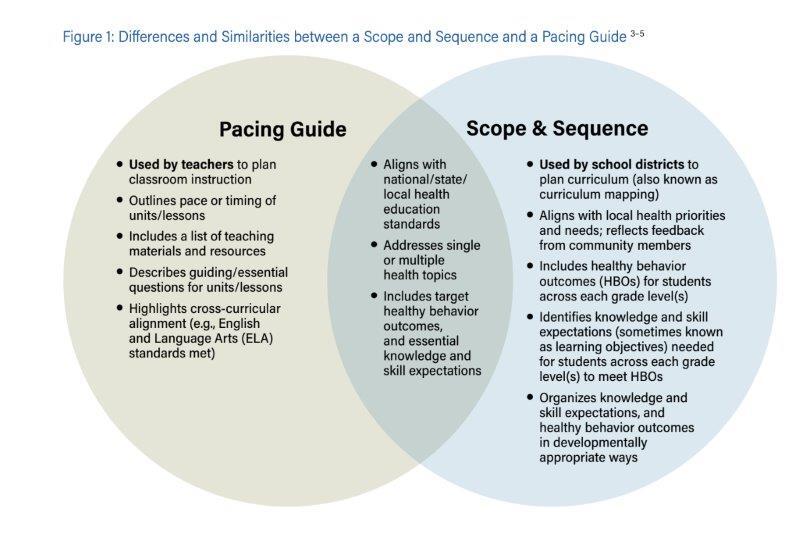
- After identifying and prioritizing the expected HBOs by grade span (grades Pre-K–2, 3–5, 6–8, and 9–12), the committee divides into subgroups to review the HBOs.
- The primary teachers immediately note that it would be impossible to meet the HBOs given the 150 minutes per year of instructional time allocated to health education in grades Pre-K to 2.
- The subgroup brainstorms ideas to increase the amount of time allocated to health education at the primary level.
- The physical education teachers propose that they can integrate the HBOs, knowledge expectations, and skill expectations related to physical activity into their physical education curriculum.
- Additionally, a primary teacher suggests that a weekly instructional block (30 minutes, Monday afternoons) currently allocated to another initiative is not an effective use of instructional time. Other primary teachers agree and note that weekly instructional block could be reallocated to health education.
- The primary subgroup recommends these two strategies for increasing the allotted instructional time for health education to the committee.
- The primary subgroup recommends these two strategies for increasing the allotted instructional time for health education to the committee.
- The committee endorses the recommended strategies and identifies ways to gather additional feedback and support from other primary teachers, physical education teachers, and school or district administrators.
- The proposed strategies are supported by the school community. Additional dedicated time for classroom health instruction at the primary level is granted: 30 minutes per week on Monday afternoons, totaling 36 hours.
- The primary teachers then select the HBOs, knowledge expectations, and skill expectations that can be met within this amount of instructional time for health education.
To view in PDF format, please click here.