

Provides Functional Health Knowledge That Is Basic and Accurate and That Directly Contributes to Health-Promoting Decisions and Behaviors
Description: This characteristic focuses on providing functional health knowledge (i.e., need-to-know information) to help students establish, manage, and maintain healthy decisions and behaviors.1 Functional health knowledge is accurate, reliable, and credible information students can use to
• Assess risk,
• Clarify attitudes and beliefs,
• Correct misperceptions about social norms,
• Identify ways to avoid or minimize risky situations,
• Examine internal and external influences,
• Select valid and reliable resources,
• Make behaviorally relevant decisions,
• Set healthy goals,
• Advocate for health, and
• Build personal and social competence for engaging in healthy behaviors.

Health instruction that has little influence on health beliefs, health skills, and behaviors is nonfunctional (nice-to-know information). Sometimes students find nonfunctional health knowledge interesting (e.g., the large intestines are about 5 feet long). However, typically there is not adequate time allotted to teach both functional health knowledge (need to know) and nonfunctional health knowledge (nice to know). Therefore, it is critical for health curriculum coordinators and health teachers to focus on functional health knowledge that supports the adoption and maintenance of select healthy behavioral outcomes (HBOs) (HECAT Appendix 3).
Resources that can help teachers determine functional information from nonfunctional information include the following:
• Seeking information from accurate, reliable, and credible sources about specific HBOs and topics
• Utilizing local/state/national data describing issues related to student health
• Using state/district standards, frameworks, or requirements that dictate content
• Aligning lessons with district/school scope and sequence, curriculum maps, or pacing guides
• Reviewing Health Education Curriculum Analysis Tool (HECAT) health-related modules that outline relevant knowledge expectations
• Determining available instructional time allocated for health education and then prioritizing the functional health information that aligns with the selected HBOs
Example 1
For this example, the unit that is being taught is Personal Health and Wellness, and the HBO for the lesson is PHW-1: Practice appropriate hygiene habits (HECAT Appendix 3). The specific focus of this hygiene habit is toothbrushing.
- When planning a lesson that focuses on toothbrushing, the teacher needs to determine the functional health knowledge that needs to be taught and the nonfunctional knowledge that can be avoided.
- Examples of nonfunctional health knowledge that should be avoided include dental anatomy (i.e., specific names and locations of teeth, such as incisors at the front of the mouth).
- Examples of functional health knowledge that should be taught include the function of healthy teeth (e.g., breaking down food, being able to clearly say words when talking), the steps of brushing one’s teeth, how often and when children should brush their teeth, and ways to keep their teeth safe.
- Use the Centers for Disease Control and Prevention’s (CDC’s) HECAT Personal Health and Wellness module to help identify and select functional health knowledge across grade spans (CDC HECAT: Personal Health and Wellness).

- The teacher first posts a picture of a child the students’ age brushing their teeth and introduces the focus of this lesson on toothbrushing as a hygiene habit related to the HBO. This focus will enable students to have a clear understanding of the outcomes and expectations of this lesson.
- The teacher then asks the students to explain why they need healthy teeth and discusses their responses with the class.
- The teacher then asks the students to identify ways to keep their teeth safe and discusses their responses.
- The students then complete a worksheet with pictures related to ways to keep their teeth safe.
- The teacher then identifies the steps of toothbrushing.
- The teacher then demonstrates the steps of toothbrushing.
- The teacher then walks the students through the steps of toothbrushing (guided practice), and then the students practice toothbrushing.
- The teacher then discusses with the students how often and when they should brush their teeth.
- The teacher distributes a worksheet for students to share with their parents or guardians related to oral hygiene.
Example 2
For this example, the unit that is being taught is Promoting Safety, and the HBO for the lesson is S-4: Apply safety rules and procedures to avoid risky behaviors and injury (HECAT Appendix 3). The specific focus of this lesson is on safety rules and procedures to safely walk along and cross streets.
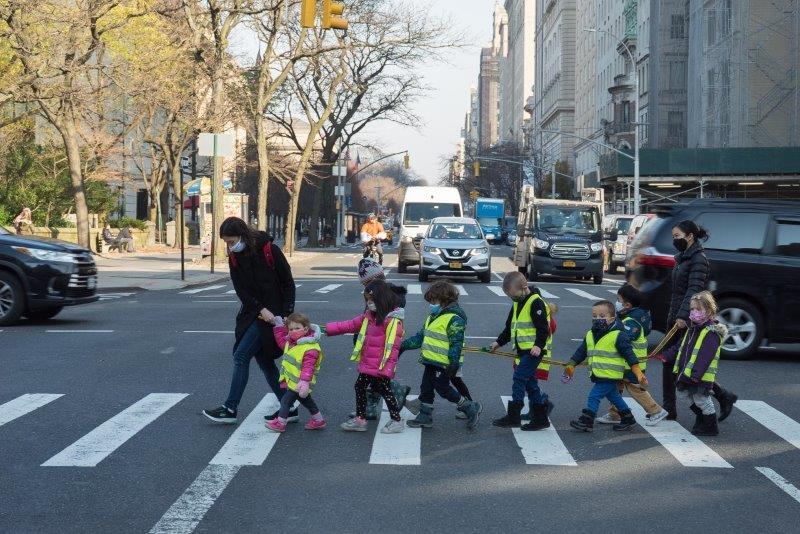
- When planning a lesson that focuses on safety rules and procedures to safely cross streets, the teacher needs to determine the functional health knowledge that needs to be taught and the nonfunctional knowledge that should be avoided.
- Examples of nonfunctional health knowledge that should be avoided include fear-laden information related to pedestrian injuries and deaths, especially pedestrian injuries and deaths among children, and unusual situations related to pedestrian injuries and deaths.
- Examples of functional health knowledge that should be taught include safe and unsafe situations and people related to walking near and crossing streets, risks associated with not following pedestrian safety rules and procedures, pedestrian safety rules and procedures including people and signs that help us safely cross a street, steps for safely crossing a street, and the benefits of following pedestrian safety rules and procedures.
- Use the CDC’s HECAT Safety module to help identify and select functional health knowledge across grade spans (CDC HECAT: Safety).
- The teacher shows pictures of children safely walking near and crossing the streets to introduce the focus of this lesson on applying rules and procedures for pedestrian safety. This focus will enable students to have a clear understanding of the outcomes and expectations of this lesson.
- The teacher provides pictures of situations in which children need to safely cross a street. The teacher asks the students to explain the situations and to identify safety rules for walking near or crossing the street.
- The teacher then shows pictures of crosswalks, stop signs, stoplights, and crossing guards and asks the students to explain how each example helps them safely cross the street.
- The teacher ends the lesson by asking students how they can use what they learned to help them safely cross the street.
To view in PDF format, please click here.